
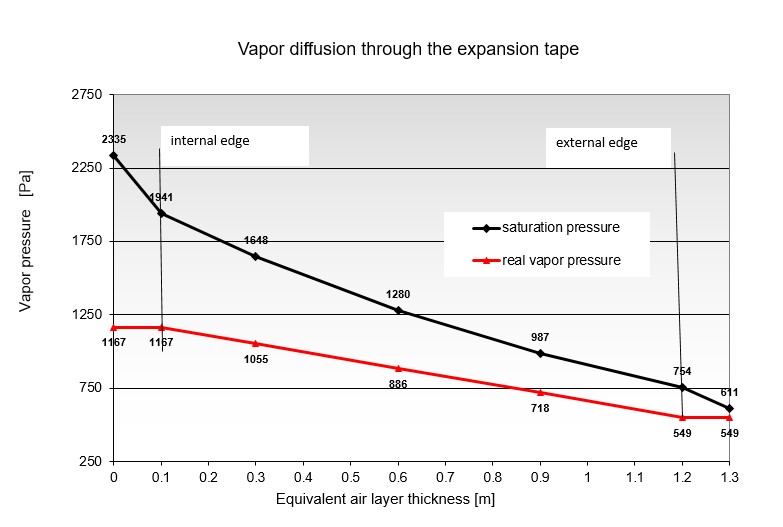
The determination of water vapour diffusion consists on determining the internal moisture content of the material under long-term normal operating conditions of the product and in approving the selected materials and their distribution in the tested product. The purpose of the procedure is to determine the consequences of water vapor diffusion through the building external shell components that may influence component durability. As part of the procedure, the calculated risk of interstitial condensation and internal moisture content of the tested building element is determined. In the case of one-dimensional moisture transfer. This can be done either using computer simulation software or by calculation according to the simplified method according to the standard:
EN ISO 13788: 2012 Hygrothermal properties of building components and building elements - Internal surface temperature to avoid critical surface moisture and interstitial condensation - Calculation methods.
The choice of software depends on the geometry of the tested element and the assumed dimensions of the heat and moisture flow. In the case of one-dimensional moisture transfer, the computer simulation software WUFI 1D or the simplified method of the standard: (EN ISO 13788, 2012) can be used. In the case of two-dimensional moisture transfer, only the simulation software WUFI 2D is used. Dynamic simulation of water vapor transfer in WUFI software requires information on:
• model geometry,
• thermal properties of the component materials under dynamic conditions, i.e. thermal conductivity, specific heat, material density,
• complete moisture properties of the material related to sorption, capillary action, water vapor diffusion.
Access to a complete set of moisture information is difficult and usually requires the use of databases associated with the simulation program.
Tests on the PM&VL7 test line included:
• Indresmat sandwich panels,
• Flex&Robust connections,
• Flex&Robust injections,
• Flex&Robust layers.
In accordance with the standard (EN ISO 13788, 2012) test result is positive when: no condensation has been found in any of the 12 months or condensation occurs at one or more interfaces during some months but, for each interface concerned, there is no net accumulation over the year as all the condensate is predicted to evaporate again, and finally there is no risk of degradation of materials during the period of condensation.